1. LiPo vs Li-Ion
LiPo
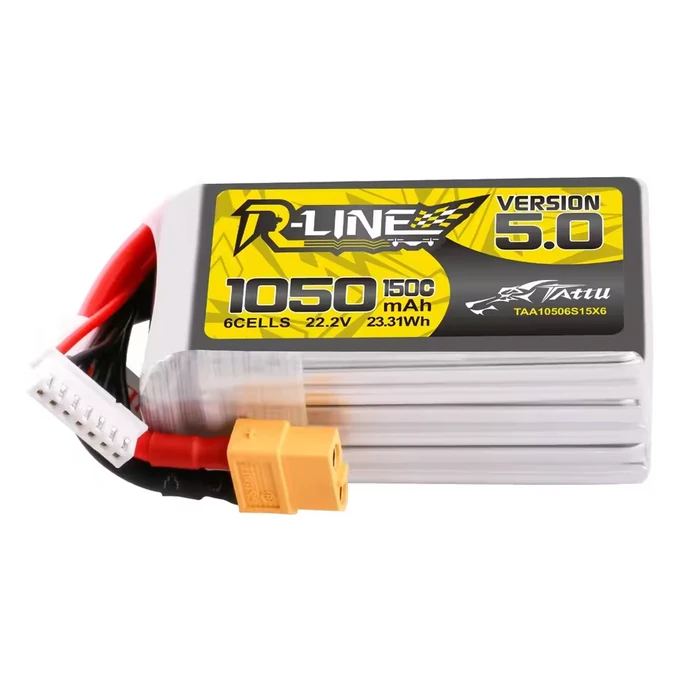
High current delivery and low sag under hard throttle. It is the standard for freestyle, racing, classic 5-inch builds and cinewhoops. It is sensitive to impact, over-discharge and poor charging.
Li-Ion 18650 / 21700
High energy density and long cruise time. It suits long range and smooth reconnaissance flights, but has lower current delivery and more sag during acceleration.
2. Cell count, capacity and C rating
S is the number of cells in series. One LiPo cell is 3.7V nominal and 4.2V when full.
| Pack | Nominal / full voltage | Typical use |
|---|---|---|
| 1S | 3.7 / 4.2V | Micro and Tiny Whoop |
| 4S | 14.8 / 16.8V | Starter 3-4 inch and some 5 inch |
| 6S | 22.2 / 25.2V | Modern 5-7 inch |
Capacity, mAh
300-500mAh suits micro builds; 1100-1500mAh is a common 5-inch balance; 3000-5000mAh+ is for larger 7-10 inch long range. More capacity also means more weight.
C rating
A rough maximum current formula is capacity in Ah x C. A 1.3Ah 100C pack gives 130A by the label formula. Real delivery depends on brand, temperature and battery condition.
3. Voltage and over-discharge
Charge LiPo in Balance Charge mode. 4.35V per cell is only for special LiHV packs. Use Storage around 3.80-3.85V per cell when the battery will sit for a few days. Avoid deep discharge below about 3.30V under load.
4. Power connectors
BT2.0 / A30
Modern connectors for 1S micro drones.
XT30
Small 2S-4S systems, often 2-3 inch.
XT60
The common choice for 4S-6S 5-7 inch builds.
XT90
Large heavy 8-10+ inch aircraft.
The connector must match the battery, power lead, ESC pads and expected current.
5. Battery safety
- Charge only while present, using a LiPo Safe Bag or an appropriate safe location.
- Never charge a punctured, swollen or heavily crushed battery.
- Use Storage mode if you will not fly for the next few days.
- After a hard crash, inspect the case, wires, balance lead and cells.
- Dispose of damaged batteries through the proper LiPo recycling procedure, not household waste.